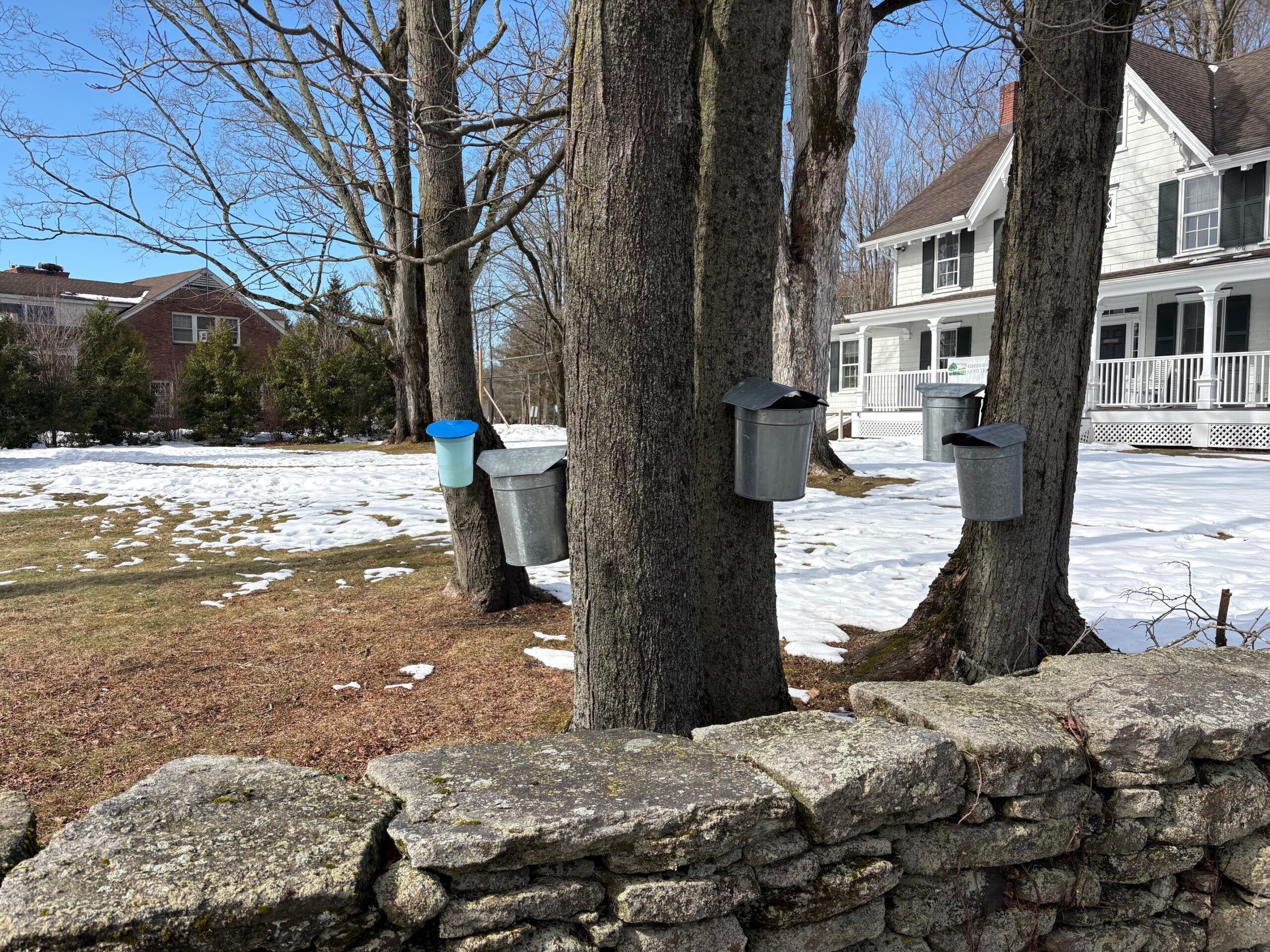
On the grounds of the Greenwich Land Trust (GLT) at the corner of Round Hill Road and Old Mill Road, several maple trees were recently tapped to collect sap used in making maple syrup. Since moving to this location, the GLT has done this in February/March to demonstrate the traditional practice that began centuries ago in New England and North America. Today it is still done not only by big maple sugar farms and commercial operators, but it can also be done by residents the way it has been handed down from early settlers.
The typical short season lasts about 4-5 weeks when the temperatures are below freezing at night and above 40-50 degrees during the day when the sap flows from the tree. Sugar maples usually have the best concentration of sugar, but black, red, and silver maples are also productive. It takes a lot of sap to make maple sugar since only 2% of the sap contains sugar. As a result, 43 gallons of sap yields just 1 gallon of maple sugar. Some people enjoy drinking the sap directly from the tree while others may boil it for a brief period to remove any potential bacteria.
If one wants to tap a maple tree in their own yard, it is pretty easy and only requires a few simple tools. This includes a power drill with a 7/16 or 3/8 inch drill bit, a hammer, a collection container (bucket or jug), and a 10-12 inch tapping spout or pipe which can be purchased. After selecting a tree, which must be over a foot in diameter, drill a 3 inch hole in trunk at a slight downward angle about 5 feet above the ground. Insert the spout with a light hit of the hammer, and attach or hang the spout. Collect sap once a day and store in a cool place until ready to begin the evaporation process by boiling. When the heat hits 219 degrees, the sap will start to brown in color and turn to a syrup which can be strained and poured into a glass jar.
During March across CT, there are over 200 sugar makers to visit where one can observe and learn about this traditional practice. Maple Sugar Festival Weekend in March 9 and 10 at the Stamford Nature Center.